

Gadi Eisenkot’s bid to replace Benjamin Netanyahu as Israel’s prime minister gained momentum on Thursday, as his Yashar party agreed a preliminary coalition deal with the left-wing Democrats.
The agreement came days after the Democrats briefly froze talks in protest at Eisenkot’s parallel negotiations with Netanyahu’s Likud party about a possible unity government.
“We promised the people that we would replace Netanyahu and defend democracy. And that is what we will do,” Democrats leader Yair Golan wrote on X. “I call on all parties to come together as soon as possible to finalise agreements and sign them, form a government, and lead Israel in a new direction.”
Under the deal, the Democrats, who won eight seats, will receive four ministries: an expanded public security portfolio; a merged labour and welfare ministry; communications; and culture and sport, which will include a new directorate for democracy. They will also chair the parliament’s powerful Constitution, Law and Justice Committee and have a seat on the committee that selects judges.
The party said the agreement included “a commitment to fully repeal the judicial overhaul”, the Netanyahu government’s controversial plan to curb the power of the courts, which sparked mass protests in 2023.
The Democrats did not get the justice ministry, which they had sought, or education, which earlier Israeli media reports had suggested they would receive. The party said the need to form a “government of change” required it to “act swiftly, reach agreements and demonstrate a willingness to compromise”.
The two sides said they were still working on final details before signing the agreement.
The numbers
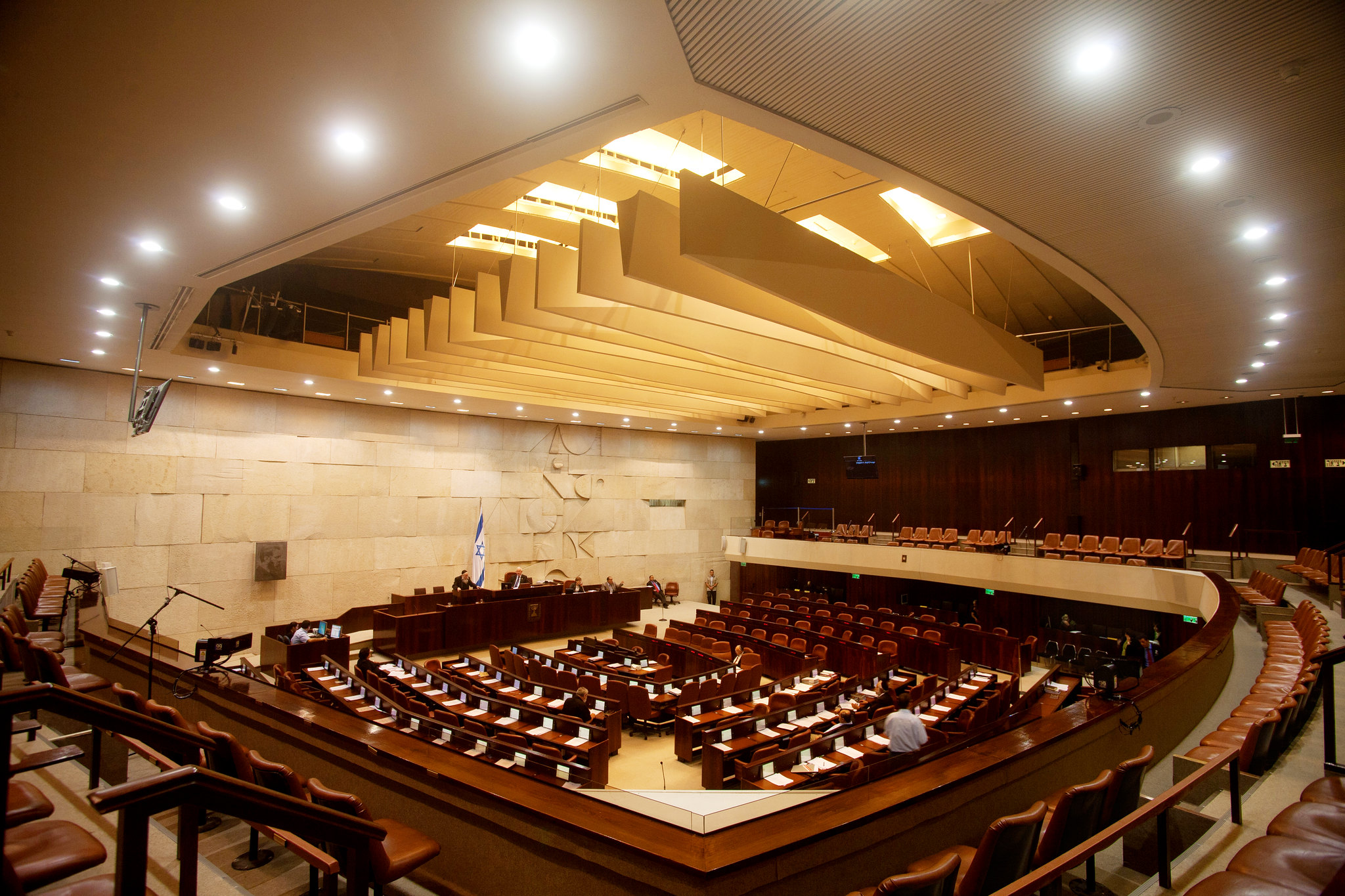
The Knesset has 120 seats, so a government needs 61 to command a majority. After the inconclusive election on 27 October, neither side has that.
| Bloc | Seats |
|---|---|
| Netanyahu’s Likud, far-right and ultra-Orthodox allies | 53 |
| Eisenkot’s bloc (Yashar, Yisrael Beiteinu, Beyachad, Democrats) | 48 |
| Arab-led parties | 19 |
Eisenkot’s bloc brings together his own centre-right Yashar party, Avigdor Lieberman’s right-wing Yisrael Beiteinu, the centrist Beyachad party led by former prime ministers Naftali Bennett and Yair Lapid, and the Democrats.
The Arab-led parties oppose Netanyahu and their votes would give Eisenkot a comfortable majority, but some of his partners have long refused to rely on them. Netanyahu remains caretaker prime minister until a new government is formed.
The opposition has already won one important vote: earlier this month, Eisenkot’s ally Matan Kahana was elected speaker of the Knesset with the backing of the Arab-led parties.
Earlier this week, Eisenkot and Lieberman agreed to sign a deal formally bringing their parties into coalition, the first such pact since the election.
Lieberman, a secular politician who has long been one of the fiercest critics of Israel’s ultra-Orthodox parties, has since shifted his position. He told Israel’s public broadcaster Kan that a government including the ultra-Orthodox United Torah Judaism party could be presented by the end of next week. “There will be a government with a Jewish majority,” he said.
He also indicated for the first time that he could back a minority government, one with fewer than 61 seats, as long as most Jewish lawmakers supported it. That could open the way to a 55-seat government made up of Eisenkot’s bloc and United Torah Judaism’s seven seats, supported from outside by the eight-seat Arab-led United Arab List, Raam.
Such a deal would not be simple. Eisenkot and his allies promised during the campaign to end the exemption that lets ultra-Orthodox seminary students avoid military service, a demand fuelled by the burden of reserve duty since the war in Gaza. Ultra-Orthodox leaders strongly oppose conscription, and United Torah Judaism is expected to join a government only after a compromise on a draft law.
Both Golan and Lieberman have rejected a unity government with Likud.
President Isaac Herzog gave Eisenkot the task of forming a government on 8 November. He has until 6 December, with the option of a 14-day extension.
The date carries personal weight. The following day marks three years since his son, Gal, was killed in combat in Gaza at the age of 25.
Eisenkot has kept several options open: a coalition with the ultra-Orthodox, support from the Arab-led parties, or a unity government with Likud. Analysts say keeping all three in play puts pressure on everyone. Netanyahu has appealed to him to form a unity government, but Likud would face pressure to let Eisenkot serve first under any rotating leadership deal. Shas, the other ultra-Orthodox party, has so far stayed loyal to Netanyahu.
If Eisenkot fails, Netanyahu could be given a chance to form a government. If he also fails, Israel would hold another election next year.
After a campaign widely seen as lacklustre, Eisenkot is now doing better than expected at the coalition-building that decides who governs Israel. Whether that is enough to end Netanyahu’s long hold on power should become clear within days.