

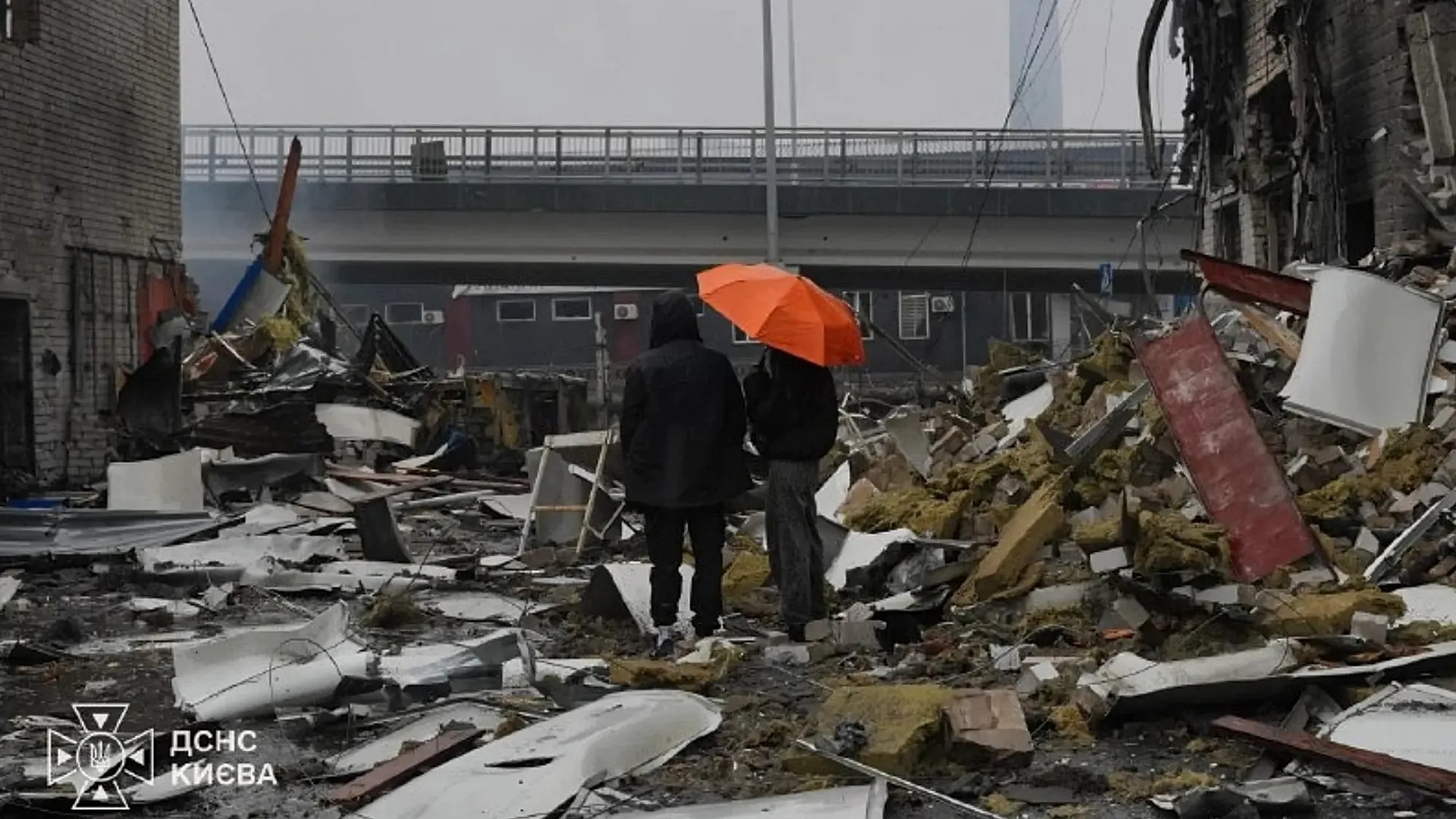
Russia launched one of the biggest air attacks of the war on Ukraine overnight, firing more than 110 missiles and about 400 drones at cities across the country, hours after peace talks between the leaders of the US, China and Russia.
At least eight people were killed, six in Kyiv and two in the western city of Lviv, and at least 28 were injured, according to Ukrainian officials.
The strikes hit three of Kyiv’s bridges over the Dnipro river, energy facilities and residential buildings. President Volodymyr Zelensky called it “one of the most massive strikes” of the war.
Ballistic missiles struck the Podilsko-Voskresensky, Darnytskyi and Southern bridges in Kyiv, which link the two halves of the capital across the Dnipro. All three were closed to traffic, adding to disruption from strikes on the city’s crossings earlier in the week.
Kyiv’s mayor, Vitali Klitschko, urged people to avoid driving into the city unless absolutely necessary. He said seven medical workers were among the injured.
In Lviv, near the Polish border and a main entry point for aid and travellers, the Sknyliv railway station was badly damaged, according to the city’s mayor, Andriy Sadovyi. Ukrainian officials also reported strikes on a hospital in Kharkiv and on homes in several other regions.
The attack knocked out power in parts of Kyiv and forced emergency blackouts in western regions including Lviv, Zakarpattia and Ivano-Frankivsk, as temperatures fell below freezing. Ukraine’s grid operator, Ukrenergo, described the situation as “extremely critical”.
Putin had threatened to retaliate after Ukraine brought down part of the Crimean Bridge earlier this week, saying Russia’s response would be “far more painful than what the Kyiv regime did to the bridge”.
Russia’s defence ministry said it had carried out a “massive strike using high-precision weapons” on military and energy facilities, port infrastructure in the Odesa region and transport infrastructure in Kyiv.
Zelensky rejected that. “Absolutely all the targets were ordinary civilian infrastructure, things that literally sustain people’s lives,” he said.
He said Russia launched the missiles in waves 20 to 30 minutes apart, a tactic designed “to make it harder to put out fires, clear rubble, and carry out repairs”. Of the missiles, 27 were ballistic, he said, and Ukraine’s air force reported that very few of those were shot down, reflecting a shortage of interceptors for its US-made Patriot systems.
The attack began hours after Putin left Shenzhen, where he met Trump and Chinese leader Xi Jinping for three-way talks. The meeting produced no breakthrough on Ukraine, and Putin said the discussions took place in a “relaxed and very intimate atmosphere”.
On his way home, Trump dialled into a meeting of the Coalition of the Willing in Berlin, attended by Zelensky, Prime Minister Andy Burnham, France’s Emmanuel Macron, Germany’s Friedrich Merz and US envoys Steve Witkoff and Jared Kushner.
According to a senior European official, Trump’s main message was that “Putin is tired, wants to end this, ready for a deal”. The official said European leaders were “constructive in response but want proof”. Trump also reportedly questioned their decision to commit €70bn in military funding for Ukraine.
Poland’s prime minister, Donald Tusk, said Trump’s words were received “very cautiously in the room”. “His belief in Putin’s goodwill seems unshakable, even though so far there are no facts to support it,” he said.
Kushner said the US wanted “to make a deal with Europe by his side”, and claimed Russia was “comfortable” with Ukraine receiving security guarantees modelled on Nato’s Article Five. Russia’s deputy foreign minister, Sergei Ryabkov, has said “quasi-Nato” membership for Ukraine would be “unacceptable”.
During the attack on western Ukraine, a Russian cruise missile landed about 50km (31 miles) inside Poland, according to the Polish defence minister, Władysław Kosiniak-Kamysz. Two other objects, believed to be a drone and a second missile, came down in nearby villages. No one was hurt.
Tusk accused Russia of an “intentional provocation”. Polish and Swedish fighter jets were scrambled on Nato’s eastern flank and Patriot air defences were activated, before being stood down.
The incident came as the UK and France lead the Coalition of the Willing’s first military exercise, involving thousands of troops from 11 countries, in Poland.
Kyiv had already faced days of drone attacks this week, which damaged two European embassies. The EU’s ambassador to Ukraine, Katarina Mathernova, said she was rushed to shelter in a hotel after a drone exploded “right above” her head. “I collapsed onto the sofa in the hotel atrium, literally shaking,” she said.
On Thursday, Burnham announced that the UK would give Ukraine more than 1,000 long-range strike drones as part of a £260m package to help it through the winter.
The Foreign Office advises against all travel to Ukraine. British nationals there should follow its travel advice and local air raid alerts.