

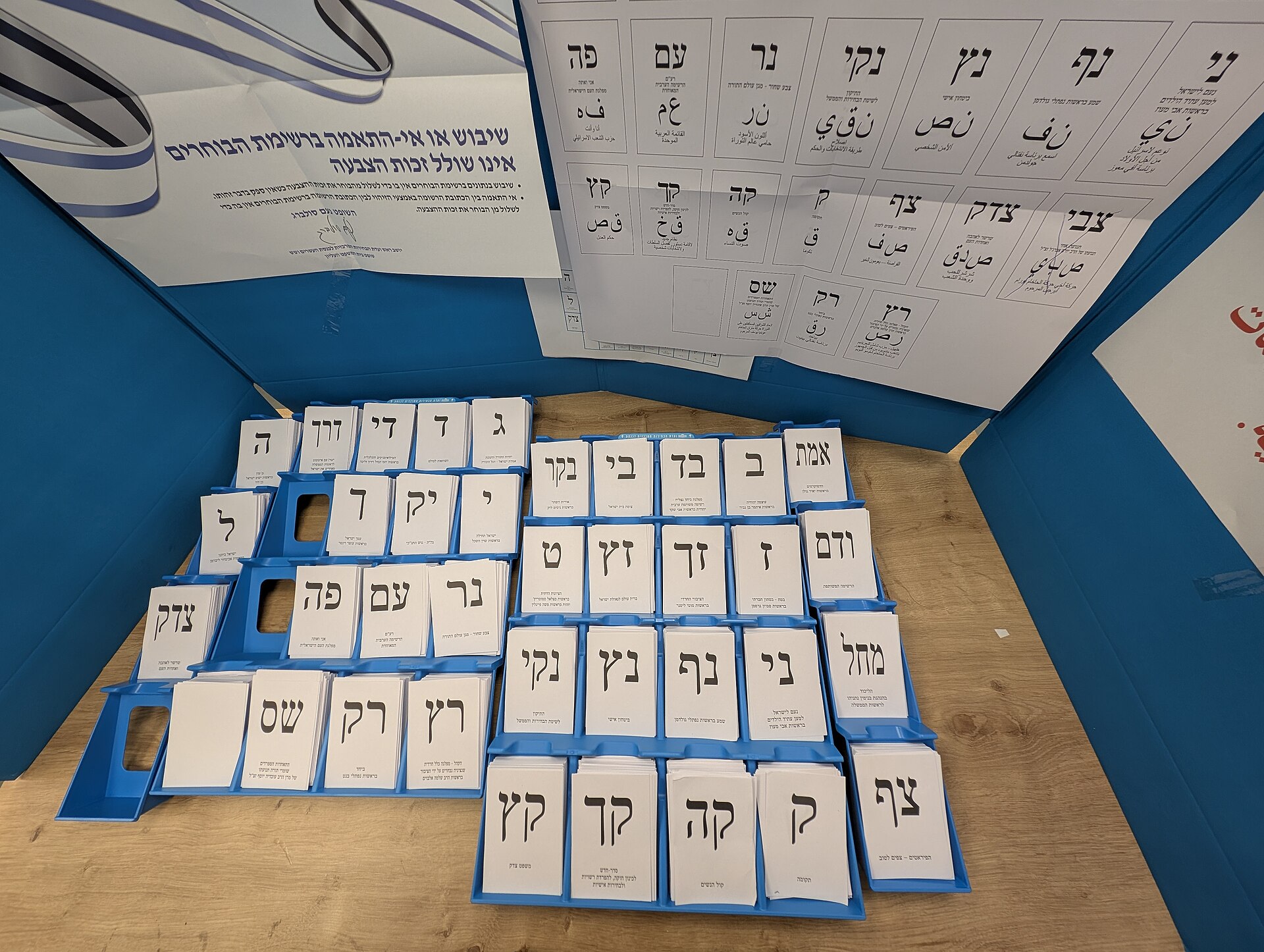
Israel’s newly elected parliament was sworn in on Tuesday without a new government, after last month’s election left Prime Minister Benjamin Netanyahu without a majority but gave his rivals no clear route to power.
Gadi Eisenkot, a former military chief who leads the centre-right Yashar party, was asked by President Isaac Herzog at the weekend to try to form a government. He has until 6 December, with a possible two-week extension to 20 December.
Netanyahu remains caretaker prime minister until a new coalition is formed.
Netanyahu’s Likud and its far-right and ultra-Orthodox allies won 53 of the Knesset‘s 120 seats. Eisenkot’s Yashar and its partners hold 48, 13 short of the 61 needed for a majority.
The two Arab-led parties, the Joint List and Ra’am, hold 19 seats and have offered to back him. Eisenkot has said they must meet conditions, including denouncing Hamas as a terrorist group, and some of his allies, including Avigdor Lieberman’s Yisrael Beiteinu, refuse to govern with them.
Eisenkot, who has called his path to power “extraordinarily complex”, could instead try to win over ultra-Orthodox parties, or form a unity government with Netanyahu. The ultra-Orthodox parties have publicly said they will not join him. However, a source in United Torah Judaism said the alliance was holding separate talks with Eisenkot and Lieberman, and wanted a law exempting religious students from military service passed before any government is formed.
If neither Eisenkot nor Netanyahu can build a coalition, Israel could face another election. “You must do everything to avoid a repeat election,” Herzog told lawmakers.
Minutes after parliament opened, Eisenkot’s allies submitted bills to set up a state commission of inquiry into the Hamas-led attacks of 7 October 2023, impose term limits on the prime minister, and repeal the outgoing government’s judicial overhaul and other laws passed over the past four years.
Netanyahu has opposed a state inquiry, and the previous parliament, dominated by his coalition, blocked one. With the backing of the Arab-led parties, which support an inquiry, the new opposition majority could pass it even without forming a government.
A motion signed by 67 lawmakers also seeks to replace the Speaker, Likud’s Amir Ohana, with Yashar’s Matan Kahana. Ohana has scheduled the vote for 17 November, saying that despite his “strong opposition” he would respect the will of the majority.
Speaking after the swearing-in, Netanyahu accused Arab lawmakers of being a “Trojan horse” whose goal was “the destruction of the Jewish state”.
“Are you prepared to be dependent on those whose purpose is the destruction of the Jewish state?” he asked those considering a government with them.
He repeated his call for a national unity government, warning that Iran was trying to revive its nuclear programme and that Israel could face international pressure to accept a nuclear-armed Iran. “Only such a government will be capable of confronting challenges of this magnitude,” he said.
He also called for an investigation into “foreign entities suspected of using big money to influence the election results”. Netanyahu has previously alleged voter fraud by Arab citizens, who make up a fifth of the population. Election officials say they are examining possible misconduct but have seen no evidence of fraud that could have changed the result.
Likud said Netanyahu stood by his view that it was “impossible to cooperate with terror supporters”, and that he would “turn over every stone for the sake of national unity”.
Netanyahu is on trial on corruption charges, which he denies, and has asked Herzog for a pardon.
Eisenkot called the speech “delusional, divisive, full of hate and shameful”, and said it had convinced him Netanyahu was “unfit to continue in office for even one more minute”. His party cancelled a meeting with Likud planned for Wednesday.
Mansour Abbas, leader of Ra’am, also known as the United Arab List, rejected Netanyahu’s accusation. “We support peace and an end to the conflict based on a two-state solution,” he said. “We condemn and reject terror, and we are also victims of terror.”
Abbas said he hoped to be part of an Eisenkot-led government. The Joint List called Netanyahu’s speech “unhinged, inciting and racist”.
The session was at times disorderly. Former prime minister Naftali Bennett interrupted Netanyahu’s speech, and far-right politician Itamar Ben Gvir interjected as Joint List leader Yousef Jabareen took his oath, asking whether he was swearing allegiance to Hamas. About 200 right-wing protesters demonstrated outside against an Eisenkot-led government.
There were moments of unity too. Lawmakers gave a standing ovation to Elisha Madan, a reservist who lost both legs fighting in Gaza, as he stood on prosthetic legs to take his oath.
Herzog urged lawmakers to “reach out a hand for compromise, even between rivals”, and said parliament was “duty bound to leave no stone unturned” in investigating the attacks of 7 October.