

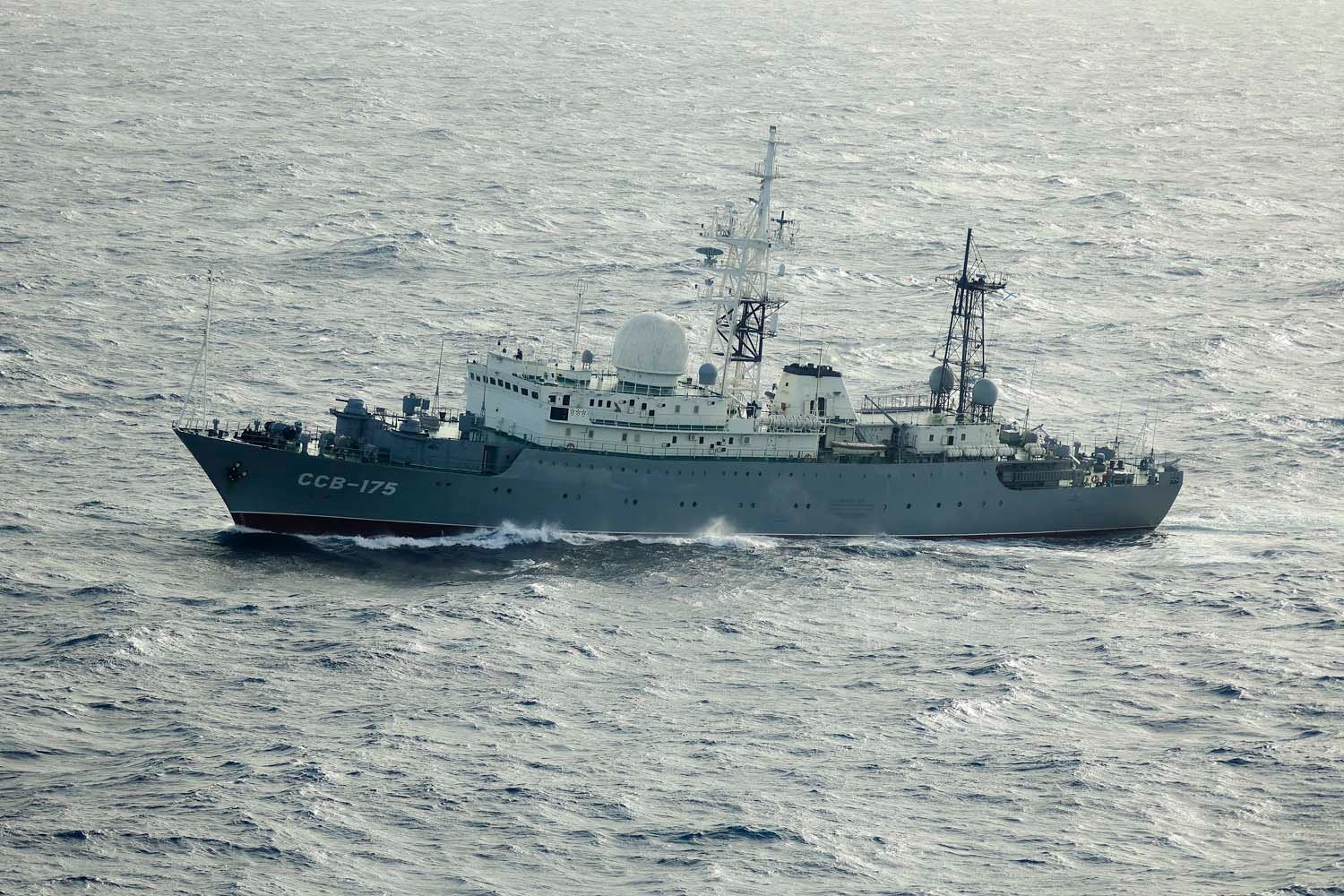
Merlin helicopters tracked the Viktor Leonov near the Outer Hebrides for 10 days, while other Russian warships escorted sanctioned cargo ships through the Channel.
The Royal Navy has intercepted a Russian intelligence-gathering ship that was “closely monitoring” a Nato exercise off the coast of Scotland.
Merlin helicopters tracked the Vishnya-class Viktor Leonov as it sailed near the Outer Hebrides from 29 September to 8 October, the Royal Navy said on Monday.
Vishnya-class ships carry electronic surveillance equipment designed to intercept communications and track the activity of other vessels.
It was one of three operations the Navy carried out between late September and mid-October to track Russian intelligence ships and warships around Britain, as Moscow’s naval activity near the UK continues to rise.
“The Russian ship was closely monitoring Nato warships taking part in allied training, Exercise Strike Warrior, off the coast of Scotland that involved more than 2,000 personnel from six nations,” the Navy said in a statement.
The helicopters were moved from their base at Royal Naval Air Station (RNAS) Culdrose in Cornwall to Glasgow Prestwick airport for the operation.
Under international law, foreign warships are entitled to sail through international waters and the Channel, and the Royal Navy routinely shadows them as they pass.
Captain James Hall, commanding officer of RNAS Culdrose, said: “I am immensely proud of the efforts of our people, who have once again demonstrated that the UK is prepared to respond to immediate operational requirements.”
“This operation has been a critical means for demonstrating to ourselves, our adversaries and the nation that we are willing and capable of securing the homeland 24/7,” he added. “The Merlin Helicopter Force stands ready to answer the call at a moment’s notice.”
Earlier this year, the Merlins were fitted with new sonobuoys, underwater listening devices, as part of a £40m upgrade to improve their ability to track Russian submarines.
In a separate operation, the Type 45 destroyer HMS Dauntless and the patrol ship HMS Tyne shadowed the Russian frigate Neustrashimy as it escorted sanctioned cargo ships through the English Channel from 1 to 14 October.
“The Russians have been forced to deploy the warship over the last three months to protect their illegal shipments,” the Navy said. Britain has sanctioned more than 500 Russian vessels, it added.
HMS Tyne, supported by a Wildcat helicopter, then tracked a second Russian warship, the Soviet-built landing ship Aleksandr Shabalin, from 11 to 14 October. It was escorting a shadow fleet vessel and a tug through the Channel, according to the Navy.
An unarmed RAF Protector drone spent more than 10 hours monitoring the vessels between late September and mid-October.
Russian activity in and around British waters rose by 25% in the first seven months of this year, compared with the same period in 2025. Moscow has used warships, civilian vessels and fishing boats to operate near the UK.
The Viktor Leonov, part of Russia’s Northern Fleet, has previously drawn attention for operating off the US east coast.
In June, Royal Marines boarded the Smyrtos, a tanker accused of being part of Russia’s “shadow fleet” of ageing vessels used to move oil in breach of sanctions. The six-hour operation was ordered by Sir Keir Starmer when he was prime minister.
Since European governments began intercepting shadow fleet tankers, Moscow has increasingly sent warships to escort them. The fleet has helped the Kremlin keep earning oil revenue to fund its war against Ukraine.
Ukraine’s military intelligence agency had identified 1,404 vessels as part of Russia’s shadow fleet as of May 2026, according to its public register.
Russia has also reportedly used fishing trawlers to gather intelligence on Britain’s undersea cables, which carry almost all of the country’s international internet and data traffic.
The interception comes amid debate over UK defence spending. On Sunday, chancellor John Healey declined to give a firm commitment to raising defence spending to 3% of GDP by 2030, saying only that Britain would “look to” hit that level.
Healey stepped down as defence secretary after Sir Keir Starmer’s Defence Investment Plan did not commit to meeting that target.
In last week’s Budget, Healey said next year’s spending review would set a target date for reaching 3%, on the way to 3.5% by 2035.
Former generals have told Burnham that Britain is not ready for war, accusing the Budget of “kicking the can down the road” on defence.
Defence Secretary Wes Streeting has said the UK must be ready for war within 1,000 days, as the threat from Russia and other hostile states grows.