

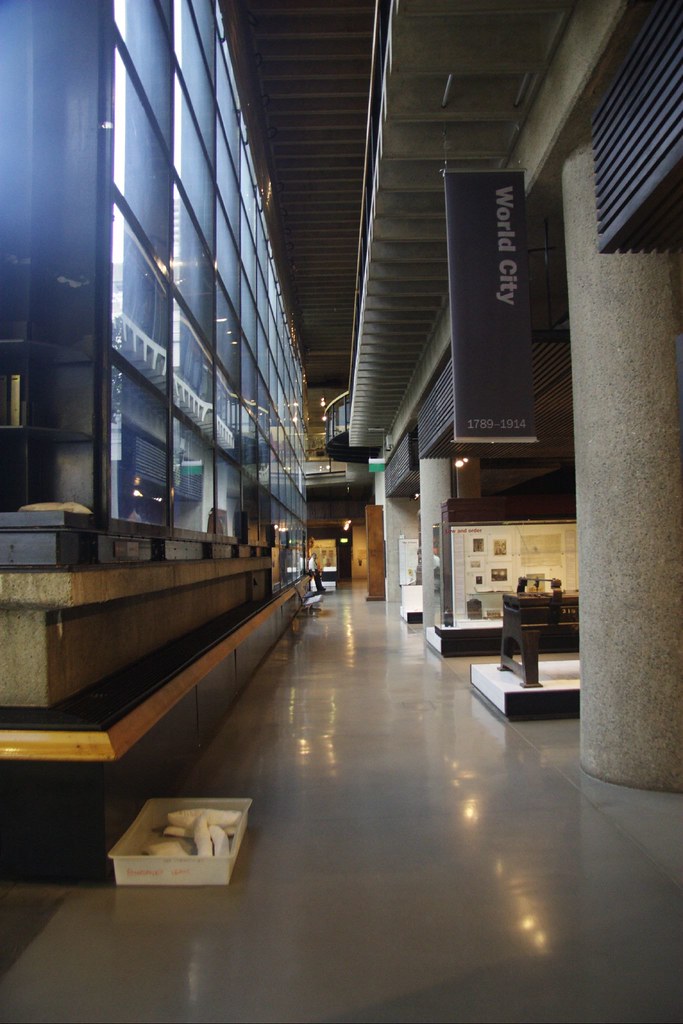
The London Museum, formerly the Museum of London, opens to the public on Saturday 28 November in its new home in the historic Smithfield market, after a £437m project that has taken a decade.
Entry is free, and the museum expects to attract two million visitors a year.
“After a decade of imagining, planning, building, and creating, it is extraordinary to finally throw open the doors and welcome people into our new home in Smithfield,” said director Sharon Ament.
The old Museum of London opened almost exactly 50 years ago, in December 1976, but its site on London Wall was notoriously hard to find. Faced with a likely £70m bill to bring the building up to modern standards, the museum decided a decade ago to move to Smithfield’s derelict General Market, which closed in the 1990s. It was originally due to open in 2021.
The project was funded by the museum, the City of London Corporation and the Mayor of London, with support from donors including Bloomberg Philanthropies, the Goldsmiths’ Foundation, the Linbury Trust and the National Lottery Heritage Fund. Stanton Williams led the design, working with Asif Khan Studio and conservation specialists Julian Harrap Architects.
Restoring the Victorian buildings was a huge task. “Whenever we’ve found historic fabric, we’ve restored it or kept it, and we want to show the layers of history,” said Alec Shaw, who led the project. “We wanted a museum that worked like the market, that allowed you to come in any corner and just walk across.”
The neighbouring Poultry Market will open in 2028, with space for temporary exhibitions, a learning centre and stores for more of the museum’s seven-million-object collection.
Visitors enter through a covered street called Real Time, where screens show data about London as it happens. It also features a sentry box painted by Banksy and a clock tower with the last bell ever cast at the Whitechapel Bell Foundry. Shards of pottery and Victorian clay pipes are set into the floor.
Beyond it is Our Time, the market’s vast former trading floor beneath a domed roof. It holds 13 large installations, including the 1757 Lord Mayor’s State Coach, the old Buckingham Palace switchboard, remnants of London’s greyhound tracks, and a mechanical giraffe in front of a lit-up NHS sign recalling the pandemic. Flocks of large plastic sheep serve as benches.
“There are grins on people’s faces, so I think we’ve pulled something rather incredible off,” Ament said.
The space is designed to be used as much as visited, with cafes, shops, late-night events and dinner clubs. Former Victorian cocoa rooms will open 24 hours a day at weekends. The first season, London Tastes, running until August 2027, explores the city’s food and is led by writers Ruby Tandoh and Jonathan Nunn.
The main collection is downstairs, in a space called Past Time, set in the market’s old railway sidings under seven-metre-high brick vaults. It sits at roughly the street level of Roman London. “We felt that right in the guts, in the earth of the city, that was the place where we should explore London,” said curator Annette Day.
About 5,000 objects trace the city’s story from its founding by the Romans to the 2012 Olympics. Highlights include the Elizabethan jewels of the Cheapside Hoard, the vest Charles I wore to his execution, Queen Victoria’s mourning dress, Emmeline Pankhurst’s hunger strike medal and Tom Daley’s diving trunks from London 2012.
There are lighter touches too: a 1960s Ford Cortina, an overstuffed taxidermy cat called Oliver, a case of toilets and chamber pots, and a chunk of the Whitechapel fatberg viewed through a porthole. A large glass wall looks straight into the Thameslink railway tunnel, so visitors can watch trains rumble past.
A recreated Roman room displays a wall painting found in Lime Street, while the Great Fire of 1666 is told through large comic-style illustrations aimed at schoolchildren. Shaw estimates it would take at least eight hours to see every object.
Early reviews have been mixed. The Guardian’s art critic Jonathan Jones said he was “heartbroken”, criticising themed displays such as “London as Ritual” and “London as Sunrise”, the loss of the old museum’s prehistory gallery, and a single case covering both world wars. “It’s one thing to lack a brain but this museum has lost its soul,” he wrote.
Ian Mansfield, who writes the London blog ianVisits, admitted he arrived with “a certain trepidation” but left impressed, calling the downstairs galleries “delightfully cluttered”. He said the layout made it hard to tell where each period began and ended, but concluded: “It might not be the Museum of London anymore, but it is very much a Museum for London now.”
Ament describes the museum as a place for everyone. “Think of this as like one of my favourite buses, the number 63 bus. You meet the world on it. And you meet the world in here,” she said. “The story of London is tough and joyful at the same time. That’s why we use ‘grit and glitter’ as a tagline.”
The museum opens on Saturday 28 November. Entry is free, but for the first couple of months visitors need a timed ticket, available on the museum’s website. It will be open daily from 10am to 6pm, and until 11pm on Fridays and Saturdays. The nearest stations are Farringdon, Barbican and Chancery Lane.